Stories
of Afghanistan No
one could travel eastwards through Asia without hearing stories of Afghanistan
- how the countyside is inhospitable and the people more so,their fundamental
trait a fierce independent of spirit and woe betide anyone who ventures into their
land. These
add to the impressions gained from a schoolboy diet of hair-raising tales from
the North West Frontier, mostly about wild tribesmen with long noses, long beards
and even longer rifles So, as we crossed the border,we felt we could blame nobody
but ourselves; and we had been advised to go south through Baluchistan (West Pakistan),
and yet here we were. And
to spoil the story - I can say we never regretted it. our route from the border
town of Taiabad was south to Kandahar, north to Kabul the capital - then out through
Jalalabad and the Khyber Pass 1,119 miles. The roads continued much the same as
in Iran,but the cars must have been getting accustomed to them and made no complaints.
Perhaps it might have been different if we had suffered breakdowns and been compelled
to stop out in the wilds. Other people might have had completely different experiences. Nomadic
tribes The
nomadic tribes did show some signs of traditional behaviour; once we were approaching
too close to their awning like tents (perhaps because of the presence of the women?)
, and an angry bearded gentleman - on quite another occasion- threw a stone at
us. At first we thought this was a hand grenade ; but in any case he missed. The
villagers counselled us against camping in the countryside,and thanks to their
hospitality we never needed to. They were uniformly courteous and helpful. Once,
drawn by unusual music,we found ourselves at a ceremonial tea party under the
trees outside a village. Immediately we were escorted to a place of honour. Clad
in our dirtiest travelling kit,we were ushered across the beautiful carpet and
seated on divans behind small tables. From all around the rectangle of chairs-mostly
less comfortable than ours-fine aristocratic looking men in spotless turbans stared
solemnly at us. At
the party Not
being unable to explain ourselves we were uneasy,fearing some case of mistaken
identity.But as it turned out we had been invited into the ceremony for the no
better reason than because we happened to be there, it being unthinkable to them
to turn us away. So we sat eating melon and drinking tea while watching with little
understanding, a Minister of the Government presenting medals and citations from
the King, Mohammed Zahir Shah,to deserving local citizens. Afterwards we spent
a free night in the local "hotel". The
method of tea preparation favoured here seems to entail boiling water,tea,milk
and sugar all together. This creates a strange and very sweet flavour, but it
is reassuring to know that both the water and the milk have been boiled. The melons
were our great lifesavers at this time. On the road we never eat a mid-day meal,
in the unrelenting sun we used to find a few slices of this juicy fruit quite
delicious. So several times a day we paused for this snack and watched the many
little whirlwhinds bowling busily along. On
the Road
They look like a geni escaping from a bottle and can grow to a couple of hundred
feet. The foot always remains in contact with the ground as it hurries along its
zigzag course, here and there, down ditches and up, across the road and away.
The top of the column lags behind trying to catch up, giving the impression of
a self-important waiter scurrying from table to table with his coat-tails flying!
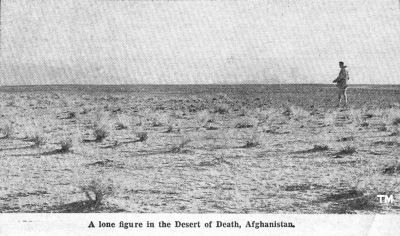
The heat was quite as high as in Iran. When skirting the Desert of Death in South
Afghanistan the temperature, in the shade of the cab of a moving vehicle with
all the windows open, was 105 degrees - out on the sand it must have been over
125. It was impossible to stand out on the desert, the heat seemed to beat you
into the ground.
Covered
women
Under these circumstances the dress of the women is quite amazing. One rarely
sees them - none were at the ceremony described above, for example, nor were any
working in the "hotel".
In Iran, the women, being Mohammedans,
are in "purdah" in spite of the efforts begun by the last Shah to abolish
it.
This involves wearing a cloak that can be drawn across the face - often
leaving one eye peeping coquettishly out! In Afghanistan they wear complete purdah.
The women - from the age of about 13 - are covered entirely from head to foot,
including arms and hands, by a one-piece garment. In front of the eyes is a piece
of fine silk or a rectangle of open-weave material to allow some slight vision.
They flit along quietly and quickly, looking - particularly when dressed in white
- like the popular idea of ghosts. They do not come into society and they do no
work except in the house.
Consequently all the traditionally female tasks
must be done by men.
Night
Vigil
A number of the people carry arms. Very late one night we drew up to inquire the
way of a villager. A man climbed casually down a ladder from a nearby flat roof,
in normal civilian clothes, with a 0.303 rifle slung over his shoulder! Fortunately
he was quite friendly. However, we decided not to stay! In fact we drove on through
that night to the capital, Kabul.
Night driving is fascinating; many forts,
the legacy of Afghanistan's troubled past, drift by in the darkness, and constant
vigilance is need to avoid making the 12 or 15 foot drop through the many broken
bridges.
The floods must be formidable, since they destroy all the smaller,
and many of the larger, bridges. Detours along dry beds of streams and rivers
are necessary. During the rains, sudden waves of up to 10 or 15 ft. high can rush
down hitherto dry gorges and are both deceptive and dangerous.
We were fortunate
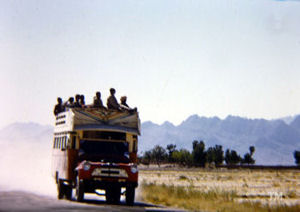
to make the descent to Kabul from a 9,000-foot pass at dawn. Ahead lay the foothills
of the Hindu Kush made up of succeeding barriers of purple hills, and the roads
were filled with camel trains and whole families bringing their livestock into
the markets.
Impressive
Eastern Afghanistan is by far the most impressive area. One can understand why
it is said that no one should be allowed to enter the country except by this route.
Kabul itself is an unexciting city built in a U-shape around a hill. Our strongest
memory is of a dingy, rambling police station full of unshaven policemen who completely
lacked the usual noble aspect of the countrymen.
Co-operation
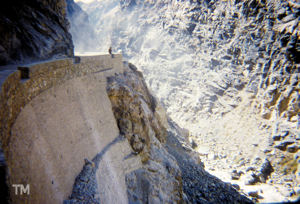
Between Kabul and the frontier a new road is being constructed through the Tangi-Garu
gorge. This really is something like a gorge. It reaches a depth of 2,000ft. The
road stands three deep upon itself at times, hanging precariously on the rock
face and plunging into tunnels often to emerge in an entirely different direction.
We christened our 16mm cine-camera here and the spectacular scenery and work certainly
deserved this honour.
We heard that Americans, Russians and Afghans were responsible
for different sections. If this is so it makes an interesting case of co-operation.
And for Afghanistan an unusual one.
Both America and Russia are doing a great
deal of development work here; but whereas the Americans are concentrating, too
altruistically perhaps, on long-term and very necessary rural development - such
as irrigation in the Helmand Valley, the Russians carry out all their work in
or near the capital - building roads and factories. Thus the people are tending
to become accustomed and reconciled to the presence and influence of their traditional
enemies from the north.
Land
unrest
We passed through the border lands during a period of unrest between Afghanisatan
and Pakistan, but saw little manifestation of this. In the villages public radios
shout excited diatribes against the iniquitous Pakistanis and the unfairness of
the non-ethnological Durrand Line agreed upon in 1893 - but nobody pays much attention.
As we passed further south, the Pakistanis were insisting that the Afghans had
been stirring up and arming Pushtu-speaking tribes on both sides of the border.
They also claimed that loyal Pakistani villagers had no difficulty in repulsing
these half-convinced marauders. Border skirmishes seem to be frequent.
Near
the frontiers all police are replaced by heavily-armed soldiers in forts or look-outs,
perched on every rocky pinnacle. One police check-point had a machine-gun mounted
on the roof and we had been warned that they shoot at any car foolhardy enough
not to stop.
Smooth
road
We stopped. A pity in a way, it would have been entertaining to return with a
bullet-hole in the car. However, there is still South America, I suppose!
Suddenly we were presented (never a word more apt) with a beautiful, smooth road
- a forerunner of those in Pakistan and India - and on this unfamiliar velvety
surface we bowled up to the border.
In Pakistan we heard birds sing in the
trees and English is spoken, and we had to reorientate ourselves to driving on
the left hand side of the road….we might almost have returned home.
Text:
Malcolm McKernan Photos:Tony
Morrison |