The
Moonflower is a cactus of the genus Selenicereus. As many of the
species flower at night the genus is remembered by the name Selene from
the old Greek word for 'Moon'. This species is known only from small parts of
the enormous Amazon forest and was named wittii at the beginning of the
20th century after a German collector. Sometimes
the plant is known as Strophocactus wittii. |
| | |
Selenicereus
wittii is generally found close to water and widely in the flooded
Amazon forests or igapós of the Rio Negro This is an immense tributary
of 'black' tea coloured water flowing from the north to enter the main river just
below Manaus. | | Selenicereus
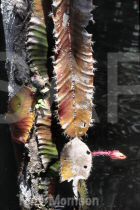
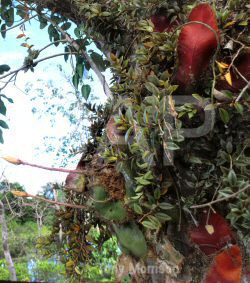
wittii is an epiphyte - it uses other plants as a foundation. Its leaf-like
flattened stems are usually attached to the trunks of trees. Some older stems
appear to have become detached and hang loosely over the water |
| | |
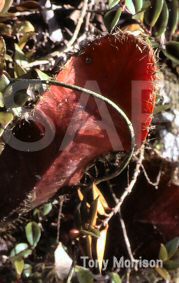
Selenicereus
wittii The colour of the flattened stems varies from green to crimson,often
on the same side of the tree.The younger stems seem to be green and frequently
the plant grows with others on the same tree. Hetre the flowers protruding on
long tubular floral structures are almost fully developed. | | Selenicereus
wittii The edges of the broad flattened stems are edged with fine,
short spines |
| | |
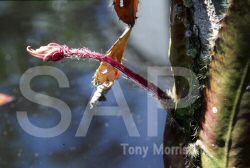
Selenicereus
wittii The
flower head and tube are part of the same plant structure groeing from the flattened
stem.The tube is covered with fine hairs pointing outwards. | Selenicereus
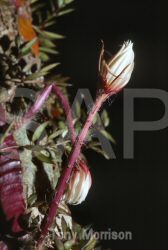
wittii Here,
soon after dusk the flower head began to open. The tube was still erect |
| | |
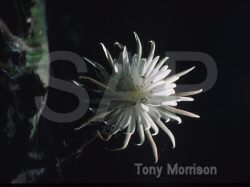
Selenicereus
wittii Once daylight had gone the flower opened rapidly often moving
visibly as the white or pale yellow perianth leaves resembling 'petals' began
to unfurl. | Selenicereus
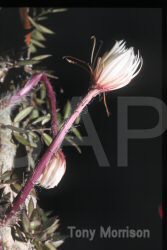
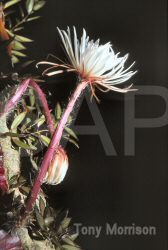
wittii After
an hour the flower on the end of its tube was almost fully open |
| | |
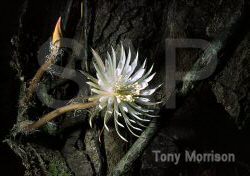
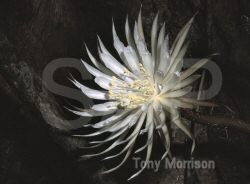
Selenicereus
wittii In the case of this plant the flower was full open long
before midnight. All the perianth leaves were long and firmly pointed | Selenicereus
wittii At this stage the flower had a faint, softly sweet perfume
attracting numerous small insects. |
| | |
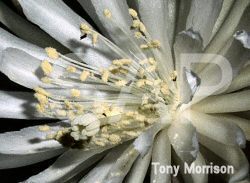
Selenicereus
wittii The insects gathered on the stamens - see the black specks top
left, centre and various in the lower half of the picture. | Selenicereus
wittii The insects did not stay all night and by the time the flower began
to close, they had gone. |
| | |
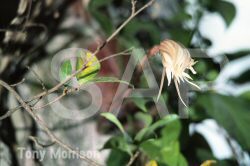
Selenicereus
wittii As dawn approachedthe perianth leaves like 'petals' began
to droop and close. | | Selenicereus
wittii By the time of first light the perianth had closed and the
flower tube drooped. The life of the flower was over |