| ||||||||||||||
| ||||||||||||||
| This story comes from the few days when Sue Loram, Margaret Mee and her friend Sally Duchess of Westminster were staying alone at the small house owned by Gilberto Castro beside the Rio Negro. Sue who is an expert cook was taking a short break from the restaurant in Rio de Janeiro she owned with David. | ||||||||||||||
The last night on the Rio Negro
'It was Sally’s last night on the Rio Negro. I decided to produce an amazing meal,
a special memory for her to take home. I approached Margaret, who was busy sketching as usual, to
let her know that I’d be gone for a few hours or so in the canoe scavenging in
the “larder of life”. I asked her not to tell Sally, who was reading inside, as
I wanted the meal to be a surprise. Margaret
laughed when I told her I was going to try and catch a fruit- eating fish, like
the delicious ones Paulo and Maria had caught for us. She said, “Remember the last time, Sue!” She was referring to my previous attempt, which
resulted in my hooking one minuscule piranha that I was far too scared to bring
onboard the canoe to clobber. Piranha
is actually a very tasty fish, but it takes a lot of experience to remove them
from the hook without their razor sharp teeth biting off a finger or two.
Unfortunately I couldn’t ask Paulo and Maria to go fishing for us as they
were far too busy preparing Gilberto's ancient boat for the long journey down
river the next day…. So off I paddled with bait, line and hook towards a tree
inside the nearby flooded forest. I had
spotted it canoeing the previous day, off-loading its mature fruit into the water. I quietly secured the canoe to the trunk.
At the first plop of fallen fruit, up came a good sized fish and the fruit
disappeared. I baited my hook with a piece of fruit and
threw the line overboard. The fish weren’t
stupid. Why risk snapping at a baited hook, with all that gorgeous fruit going
begging…with no strings attached? I remembered Paulo imitating falling fruit to attract fish
by carefully making a plopping sound with a weight on the end of a line and pole. Meanwhile, Maria would be ready with the gaponga to catch
any outwitted fish [it's a simple device to attract fish using a weight that 'plops'
into the water like falling fruit] . This method, of course, needs two people
and a steady canoe. After what seemed like hours, I gave up the idea of catching
a fruit-eating fish and canoed to the nearby igarapé [a channel]
to try my luck there. Eventually, after nearly capsizing the canoe,
my endeavours were rewarded. Two fish of a totally unknown species (at least to
me) lay flapping in the bottom of the boat. I had the main course, now for the dessert. I plucked a fruit out
of the water, after a short tussle with a furious fruit-eating fish. I wasn’t
sure what it would taste like once peeled, so I paddled over to a nearby fig tree.
No, the fruit was too small and hard, and then I spotted some palm fruits within
reach of my machete. These small fruits
if boiled long enough in salty water can taste quite good. Honest! Now to get back to prepare the feast! Margaret and Sally were having a siesta, as I laid out my
spoils. I cautiously tasted the “fish” fruit. Mmm!
Definitely chewy, with traces of super-gloss that made my lips stick together.
So off I went again, this time in
search of my favourite fruit - Cupuaçu, it's a relative of the cacao
/ cocoa and soft and semi-sweet inside. I was
pulling back the the undergrowth to see the ground because I had heard
a loud thump in the night, the tell-tale sign of a falling Cupuaçu. It
must be lurking somewhere. It felt like hunting for treasure and sure enough there it
was, a large heavy brown fruit with a rock hard shell.
But I was equipped to deal with it. I had brought a hammer, chisel and
scissors with me, plus a bowl for the pulp (I didn’t want to wake up Margaret
and Sally). After four almighty blows around the centre of the
shell, I found I could prise it apart
with the chisel. Now I had to cut the
delicious fibrous pulp from the many large black seeds, which were not so delicious.
After a half hour’s toil, I had separated
a pile of glutinous fruit flesh which would, hopefully, soon be transformed into
a mouth-watering dessert. Next job was to boil the palm fruit, clean the fish, and
get the lumps out of what remained of our farinha -[manioc flour].
The Amazon variety of farinha is coarse, bright yellow and gritty
(especially that which gets left at the bottom of the tin). It is made from mandioca
root and is eaten with every meal in the Amazon as a source of fibre (you won’t
get IBS if you eat this stuff every day). It occurs to me now, all these years later, what a challenge
it was to make a meal out of such ingredients and I wonder what a cook on “Ready,
Steady, Cook” would make when presented with a bag containing : 2 unknown Amazonian
fish, 1 rock hard cupuaçu, 2 handfuls of hard palm fruits and 200 grams
of coarse mandioca root. No much,
I suspect!! Anyway I digress. It
was almost dusk and Sally and Margaret prepared the table for dinner near the
huge Buriti Palms, just as a large flock of parrots were heading in our direction
from across the Anavilhanas to roost in these very same palms. The frogs and toads were just cranking up for their evensong. The parrots landed overhead and set about
their noisy business of roosting just as I brought the fish to the table. I divided it up the best I could and passed
around farinha, boiled palm fruits
and rice.
As we started to eat, there was a hush as finally the parrots
settled. The faces of my two friends were non-committal as they chewed. Then Sally started laughing, “Sue”, she said,
“for someone who runs a successful restaurant, this meal is truly awful”.
Margaret, who was somewhat more diplomatic, just said giggling “No Sue
it’s certainly not one of those recipes from your Aphrodisiac food festival”.
They were right, of course. Yuck! it was truly awful! The
unknown fish was pronounced by Margaret to be a scavenger fish. It was mostly
bones and had certainly not been snacking on seeds or
fruit ! The farinha was still gritty, and the palm fruit was a tasteless
mushy mess. The rice was good though ! Margaret
said hopefully, “I expect the dessert will be better, you can’t go wrong with
Cupuaçu”.
Can’t you? I had
tried very hard to break up all the fibres and whipped it for ages together with
our last tin of condensed milk. But when I was serving,
it stuck to the serving spoon like over-cooked porridge, and went “blop”
onto the dessert plate. By this time all three of us were laughing hysterically and
woke up all the roosting parrots above us. They joined in the laughter, as only
parrots can, and it seemed the whole Amazon was mocking my disastrous meal…….. After the meal, we had a competition describing the best
meals we’d ever eaten. (If it were the
worst meal it would surely have been the one we’d just had !).
Sally, being Sally, had the best stories to tell of banquets with the Sultan
of Brunei, dinners with her nephew (the richest man in England) etc. etc. Margaret
and I, of course, couldn’t even begin to compete, so we just sat back while Sally
entertained us with her incredible experiences and descriptions of wonderful food.
At the end of it I said to Sally “After this I expect you won’t want to
visit our restaurant when you get back to Rio”.
She retorted “I wouldn’t miss it for the world, I’ve got to tell your partner
David all about the feast you’ve just prepared, especially the glop”.
For that’s what she’d decided to call the dessert.
A combination of glutinous and slop. Great!
I knew I would never live this down……….. After we’d cleared away the bones of the meal Sally said
“Sue, I’ve got a huge favour to ask, there’s something I’ve been wanting to do
every since arriving here at the hut.” She looked longingly at the dark water,
then proceeded to explain what it was. I
replied “No way! That’s far too dangerous!”
She then said “If you do this for me, I promise I will never tell anyone
about that meal”. I laughed and said “OK
Sally, you win” and then proceeded to get ready for the daring deed…..….
| ||||||||||||||
*INPA
is the world renowned Brasilian National Amazon Research Institute | ||||||||||||||
| Every care has been taken to check the information on this page. If you feel there are inaccuracies or that you have details to add please send an e-mail to the editor. This © Sue Loram material may be used free of charge by scholars and for other non-commercial purposes. Please credit Sue Butler-Cole. Nonesuch Expeditions.For any other use please please turn to our.. CONTACT INFO | ||||||||||||||
|
 Sue
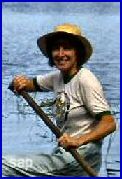
lived in Brasil for eighteen years from 1974 to 1992. She moved from Rio de Janeiro
to Manaus a city in the heart of the Amazon forest in late 1979 where she lived
with her boyfriend the ecologist Dr. John DuVall Hay. Very quickly she found herself
working for an INPA* / WWF project. In 1982 she joined Margaret Mee on a journey
to the igapós or flooded forest of the Rio Negro where they discovered
some dying flowers of the Moonflower cactus. Sue moved back to Rio de Janeiro
in late 1982 where she became one of Margaret's closest friends. Then in 1988
Sue was part of the team responsible for the success of Margaret Mee's final Amazon
journey when she painted the opening of the Moonflower. Margaret died in an accident
later in the same year and in 1989 Sue joined the same team to visit the cactus
again and fix a memorial plaque to a tree. Sue who is now married, lives in Portugal
with her long time friend and business partner David Butler-Cole This is one of
a series of short, intimate reminiscences of her times with Margaret Mee
Sue
lived in Brasil for eighteen years from 1974 to 1992. She moved from Rio de Janeiro
to Manaus a city in the heart of the Amazon forest in late 1979 where she lived
with her boyfriend the ecologist Dr. John DuVall Hay. Very quickly she found herself
working for an INPA* / WWF project. In 1982 she joined Margaret Mee on a journey
to the igapós or flooded forest of the Rio Negro where they discovered
some dying flowers of the Moonflower cactus. Sue moved back to Rio de Janeiro
in late 1982 where she became one of Margaret's closest friends. Then in 1988
Sue was part of the team responsible for the success of Margaret Mee's final Amazon
journey when she painted the opening of the Moonflower. Margaret died in an accident
later in the same year and in 1989 Sue joined the same team to visit the cactus
again and fix a memorial plaque to a tree. Sue who is now married, lives in Portugal
with her long time friend and business partner David Butler-Cole This is one of
a series of short, intimate reminiscences of her times with Margaret Mee
