Pathways to the Gods A PROJECT TO RESOLVE THE NASCA MYSTERY 1976-1978
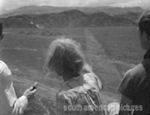
The project produced a plausible answer to the mystery and it has stood the test of time. It is still recognised today by archaologists and historians. This page will be divided into several sections and some will contain previously unpublished parts of the investigation First steps Tony Morrison and Mark Howell crossed the Nasca desert in 1961 with the University of Bristol Trans-Continental Expedition but at ground level they failed to see the curious markings.
Then
in 1963 accompanied by Allan Reditt, they made a film for BBC TV about the mystery.
At the time the markings were known 'hands on' to a handful of archaeologists
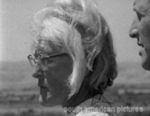
and Maria Reiche a German mathematics teacher who lived much of her life searching
for an answer to the riddle. Maria believed they had an astronomical meaning and
were an ancient calendar.
Early in 1968, Tony was asked by the BBC Archaeological and History Unit to make a short report on the work by Gerald S. Hawkins. Professor Hawkins was a British-born mathmetician and computer expert working in the USA who considered Stonehenge in Wiltshire, England to be a Neolithic computer.
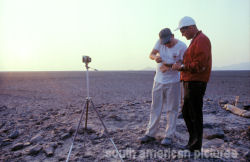
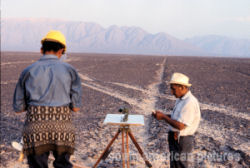
Gerald Hawkins, prompted by Tony had persuaded the National Geographic Society, Washington,DC USA to fund a meticulous survey of the markings so he could input the data to a computer programme. The machine would check to see if there was any significant correlation between the main delineations and the rising ,setting or other significant positions of visible objects in the sky - sun - moon - stars and planets. First results Back in 1968 communications between Nasca and the USA were extremely poor so the preliminary survey data were sent by telephone from Nasca to Arequipa approximately 400kms southeast at an altitude of 2380m . There in clear Andean air outside the city the Smithsonian Institution,Washington had established an observatory for photographing satellites - more specifically the orbits of the Apollo mission preparing to land on the moon. From the Smithsonian observatory the data was transmitted to the Smithsonian computer in Washington and the results returned in the same way. Tony says. " I can remember crowding around a telephone in a tiny hotel in Nasca waiting to hear the result. The line to Arequipa was poor but we could hear enough. There was no correlation between the alignments and any known positions of heavenly bodies over a period of 10,000 years. Maria's astrononical theory seemed to be dead ". The era of Spacemen. While the computer was churning out the results of the survey a Swiss writer Erich von Daniken was launching a book with a stunning theory that was destined to send thousands of tourists to Nasca. Von Daniken 'what if the lines were laid out to say to the gods: Land here'. The idea of ancient astronauts using the desert as a spaceport caught a public imagination already warming to the idea of the first manned Apollo mission. A lucky break in Bolivia. Tony and Marion Morrison were frequent visitors to Nasca and Maria became a close friend. But Tony had never been happy with Maria's theory which he often discussed with the academics he met during his journeys in the Andes mountains. Dr.David Preston a geographer from Leeds University was with his wife Rosemary in Bolivia. David's work with the Panamerican Union took him to some far flung corners of the mountains and he saw some strange paths on the on the high plain known as the Altiplano close to western side of Lake Poopo . Tony also received similar reports from a Polish geologist Piotr Zubrzycki who was prospecting in the same area for the Bolivian National Geological Corporation. The first lucky break was when, with Marion, Tony found a small sacrificial 'altar' hearth at the top of a hill in Carangas, a 3700 m high semi - desert. From the hearth, lines or perhaps paths radiated in different directions to points in the landscape below. The scene resembled the paths or lines radiating from hills near Nasca. " It was quite remarkable and I began to wonder if the lines or paths rather than radiating from the hills were in fact converging on them' To be continued
| ||||||||||
| ||||||||||