| |||||||||||||
| |||||||||||||
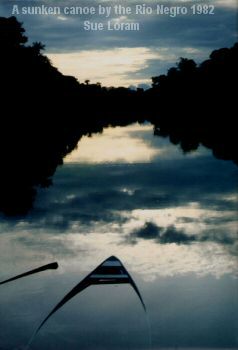
| Sally Duchess of Westminster, widow of the Fourth Duke of Westminster who had been Englands' richest person was approaching 79 and outside her family was one of Margaret Mee's closest friends in London. Sally Westminster had travelled with Margaret on an Amazon journey in the 1970's and had helped with hospitals and recuperation for two hip operations. Sally herself was not without hip problems and when she turned to Sue Loram on her last night beside the Rio Negro and asked for a canoe trip by the light of the stars, Sue was not sure what to say. Margaret was just days off seventy nine. The trip to find the Moonflower had been a wonderful success and to finish it with a disaster was unthinkable. | |||||||||||||
What Sally wanted was the impossible. She had asked me to take Margaret
and her out on the Rio Negro in our old unsteady canoe in the middle of the night
! She said that she wanted to experience paddling under the Milky Way. I told her no, in no uncertain terms, making the points one by one on my
fingers: -
And most important of all Margaret has recently had both her hips operated
on, and you, Sally, well it wasn´t long ago that you badly injured your leg in
that rafting accident in Fiji ! -
And lifejackets? There’s only one between the three of us. Paulo and Maria had taken the riverboat (where
the other life jackets were kept) to prepare for the journey to Manaus the next
day and their home was too far way for me to make contact at this time of night.
Before getting into the canoe, I placed an oil lamp firmly by the edge of
the riverbank. My passengers on board,
I gingerly climbed into the canoe and gently pushed off. Sally jokingly said “I think I heard a “glop”
over there, Sue” and she and Margaret started laughing, making the canoe rock
dangerously. I replied, “Please Sally,
no more references to that awful meal. I
told you I would do this on condition, you would forget it. If you make us laugh, we’ll capsize."
I admonished her. “ If we talk, keep it serious………” And so we did. The further away from the riverbank and trees I paddled, the brighter the
stars appeared and the fainter the frog and toad evensong became. It was magical. We breathed in the pure, warm night air and Margaret and Sally begged
me to go out even further. I tested the
water to check the currents, luckily there were none. This part of the river is best described as
a “backwater”, being protected by the long narrow island opposite the hut. The main river channel, where the strong currents
are, was the other side of this island. Being the month of May, the width of the Rio Negro, where we were,
had swollen to around 30 kilometres or so. Between us and the distant INPA floating ecological research station
(where Margaret and I had stayed in 1982) there was an incredible maze of islands
where the forest was flooded by up to around 12 metres at this time of year.
It was so easy to become lost in the maze that you should only journey
there accompanied by an experienced local boatman such as our Paulo. Floating on the deep water we looked up in wonder at the shooting stars.
We had a sense of timelessness - no-one dared talk until Margaret said
in a whisper “Oh, look down into the river, what do you see?”
There below us were dozens of tiny electric fish flashing like glowworms
in the inky black water. We had the impression that their illuminated darting
was mirroring the falling stars above us. We
held our breath, drinking in the sensation of it all, not wanting this precious
moment to pass. It was as if Mother Nature
was putting on a special light show, a “son et lumière” for Sally’s last
night in the Amazon, and it certainly made up for the dreadful supper….…. We were brought back to earth by a slight splashing sound:
Uh-oh! I thought here come those playful dolphins and if they start nudging the
canoe, we’re definitely going to capsize. When
I looked back towards the hut, the lamp appeared as a tiny dot in the distance.
It was time to go back to safety, but when I started turning the canoe,
I heard “Oh no, not yet, please”. I pleaded with my two dear friends. “Look, we mustn’t go out any further,
because if we do, we’re in danger of picking up a current and being swept away
downstream.” A slight exaggeration on
my part but they grudgingly concurred; we’d stay just where we were. After a while, in the following silence, we
agreed that this evening would be one of our most treasured memories. It felt like we had finally come home. It was spellbinding and it wasn’t long before our thoughts turned to what
is reality, what is illusion and what is destiny. It made us return once again to our recent amazing experience of
being in exactly the right place at the right time for Margaret to meet with the
moonflower. I remember Sally saying that she had read somewhere that the most obvious
illusion we live under is that the colour of the sky is blue. If we care to think
about it, we all know - from space travel - that it is really black. Even the
Milky Way, encircling the heavens above us, is mostly an optical illusion.
Just then I looked up and said “Look at that falling star, ah but then
it’s not a star at all it’s just a lump of meteor burning up as it enters earth’s
atmosphere”. Margaret laughed and said “Reality’s not very
poetic is it!” To which Sally immediately
said, “Dear Margaret, you’re capturing
the moonflower the other night was acute reality, it felt like time standing still.
I shall never forget that hushed moment as it slowly opened, releasing
its perfume, and watching you sketching and painted it at every stage until it
bloomed, and then died right there in front of us.
Now that was reality and pathos, possibly one of the most poetic and romantic
experiences any of us present could ever have”. Our imaginations were running riot out there under the starry canopy.
I quietly brought up a subject (which I had recently read in Time Magazine)
about the ultimate escape from time and death by cryogenics, where space travellers
could be frozen for long journeys through the universe and then brought back to
life at some distance time. We looked
up into the great expanse of the Milky Way and tried to imagine what the next
century would be like. After giving it
some thought we decided no we wouldn’t want to go there….
We unanimously decided we would much rather travel back in time than forward;
the future will consume us quickly enough!! Sally
thought that, for Margaret, it would be far better if she went back in time to
perhaps around the 1850’s when H.W. Bates was travelling around the Amazon. Margaret agreed, she said that if she were
unfrozen, say 100 years into the future, then there wouldn’t be any tropical forests
left, and no rare species for her to sketch, and that wouldn’t do at all.
No, it was definite, we would prefer going back in time, and particularly
fancied the idea of joining up with the likes of Bates and Wallace and travelling
with them in an Amazon, touched only by nature. At that moment we detested the thought of returning to civilisation. Particularly as we would have to pass by all
the deforestation and the eerie charcoal ovens. “Tree gas chambers” was what Margaret
called them. They were dotted all along the riverbank, spouting smoke as they
ate their way steadily through one noble tree after another. Then, we would be
faced with the disgusting squalor around the port of Manaus, our destination the
very next day. It was now time to go back to our hammocks. Gently turning the canoe around, it was as if the lamp on the distant
shore was pulling us back to reality. Little
did I know then that within a year Greville, Margaret’s husband, together with
myself and a handful of very special friends would be coming back to this same
spot to scatter her ashes on the Rio Negro and nail a plaque to a tree close to
where we had Sally’s last supper. Margaret was right, the Rio Negro
is a much safer place to be in than so-called civilisation……… | |||||||||||||
*INPA
is the world renowned Brasilian National Amazon Research Institute | |||||||||||||
| Every care has been taken to check the information on this page. If you feel there are inaccuracies or that you have details to add please send an e-mail to the editor. This © Sue Loram material may be used free of charge by scholars and for other non-commercial purposes. Please credit Sue Butler-Cole. Nonesuch Expeditions.For any other use please please turn to our.. CONTACT INFO | |||||||||||||
|
 Sue
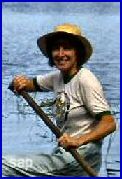
lived in Brasil for eighteen years from 1974 to 1992. She moved from Rio de Janeiro
to Manaus a city in the heart of the Amazon forest in late 1979 where she lived
with her boyfriend the ecologist Dr. John DuVall Hay. Very quickly she found herself
working for an INPA* / WWF project. In 1982 she joined Margaret Mee on a journey
to the igapós or flooded forest of the Rio Negro where they discovered
some dying flowers of the Moonflower cactus. Sue moved back to Rio de Janeiro
in late 1982 where she became one of Margaret's closest friends. Then in 1988
Sue was part of the team responsible for the success of Margaret Mee's final Amazon
journey when she painted the opening of the Moonflower. Margaret died in an accident
later in the same year and in 1989 Sue joined the same team to visit the cactus
again and fix a memorial plaque to a tree. Sue who is now married, lives in Portugal
with her long time friend and business partner David Butler-Cole This is one of
a series of short, intimate reminiscences of her times with Margaret Mee
Sue
lived in Brasil for eighteen years from 1974 to 1992. She moved from Rio de Janeiro
to Manaus a city in the heart of the Amazon forest in late 1979 where she lived
with her boyfriend the ecologist Dr. John DuVall Hay. Very quickly she found herself
working for an INPA* / WWF project. In 1982 she joined Margaret Mee on a journey
to the igapós or flooded forest of the Rio Negro where they discovered
some dying flowers of the Moonflower cactus. Sue moved back to Rio de Janeiro
in late 1982 where she became one of Margaret's closest friends. Then in 1988
Sue was part of the team responsible for the success of Margaret Mee's final Amazon
journey when she painted the opening of the Moonflower. Margaret died in an accident
later in the same year and in 1989 Sue joined the same team to visit the cactus
again and fix a memorial plaque to a tree. Sue who is now married, lives in Portugal
with her long time friend and business partner David Butler-Cole This is one of
a series of short, intimate reminiscences of her times with Margaret Mee